Kansas City, MO

Hyatt Regency Hotel Walkway

Scope/Solutions

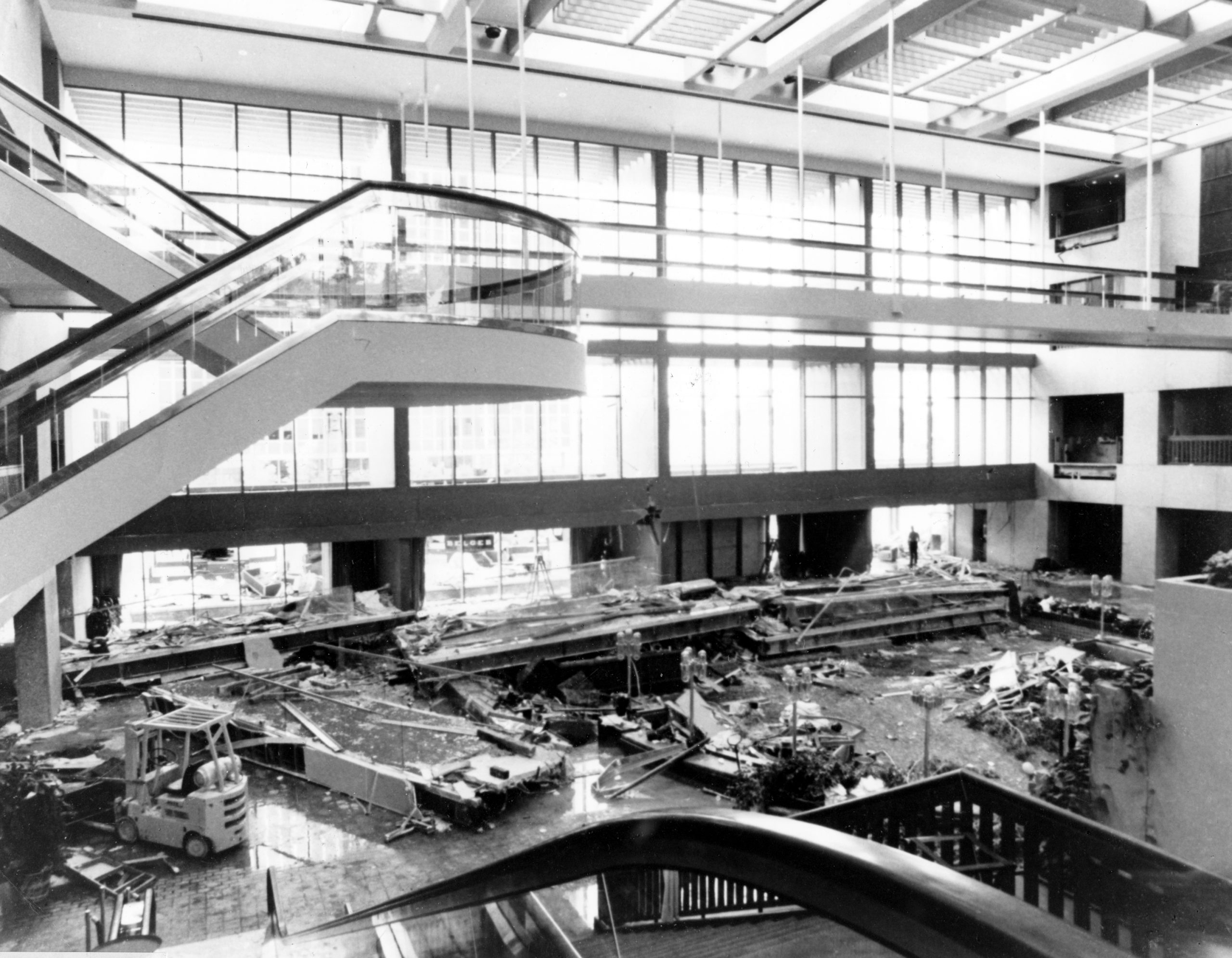
In July 1981, two suspended walkways spanning the dramatic atrium of the Hyatt Regency Hotel collapsed during a weekend Tea Dance.  As a result, 114 people died and hundreds more were injured. Following the collapse, the construction manager’s insurance company retained SGH to determine the cause of failure and examine the responsibilities of the design and construction team members.

The Hyatt Regency Hotel was approximately a year old at the time of the collapse. Unknown to anyone, the walkways were seriously defective and were on the verge of collapse from the time of initial construction. The walkways at the second and fourth floors were 8 ft wide and 120 ft long and suspended by slender hanger rods from the roof structure, creating the impression of thin, ribbon-like structures floating in space.

SGH determined that two errors led to the failure: the design of the hanger rod/box beam connections was grossly flawed and a change in the hanger rod arrangement during construction doubled the load that the flawed connections were required to bear. We attributed the errors to a widespread breakdown in communication and quality procedures during design and construction. We also concluded the associated parties missed many opportunities to avert the failure.
Project Summary

Icon: completion-date

1983

Completion Date
Solutions
Failure Investigation
Services
Structures | Advanced Analysis
Markets
Commercial
Client(s)
Blackwell Sanders Peper Martin, LLP
Specialized Capabilities
Failure Analysis

Additional Projects

Midwest

801 Grand Avenue

The plaza at 801 Grand Avenue, originally constructed in the 1980s, suffered from water leakage into the underground parking garage, paver movement, and paver deterioration. SGH investigated the causes of leakage and paver deterioration, recommended a remedial program, and designed repairs.
Explore
Midwest

325 North Ashland Avenue

SGH evaluated the existing structure’s ability to support the proposed vertical addition and proposed strengthening concepts for the gravity- and lateral-load-resisting systems.
Explore