Project
September 24, 2021
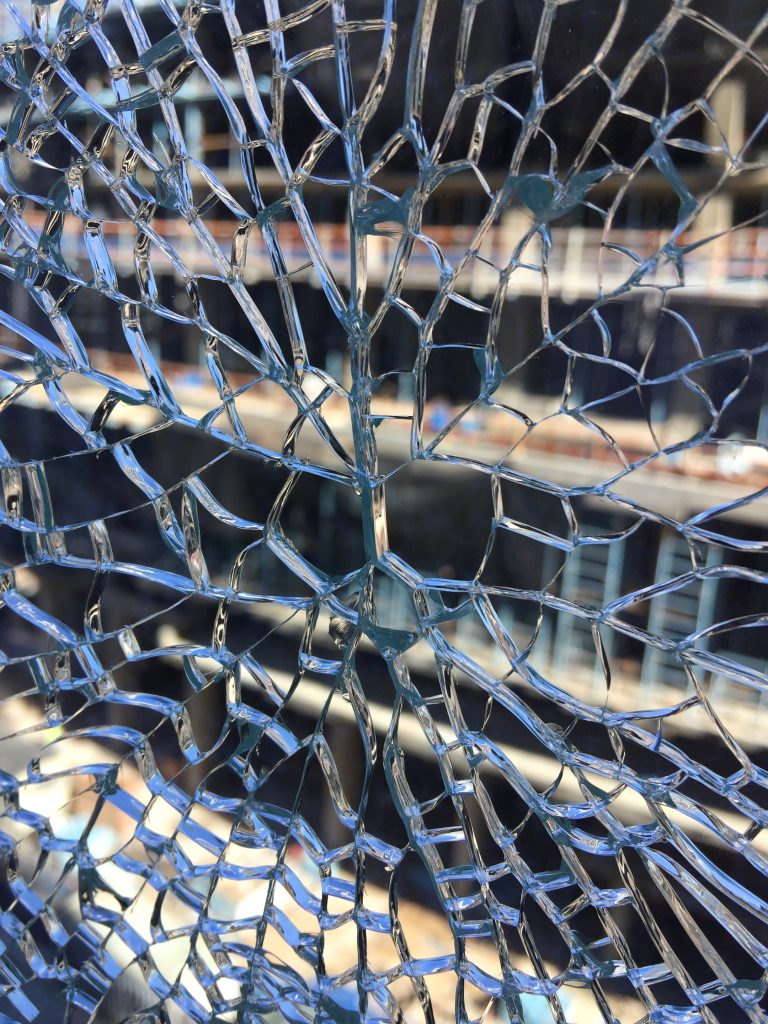
This article was originally published in July 2018 by John A. Jackson and Thomas A. Schwartz. It has been refreshed and updated to further expand on the subject, including updates in industry standards and codes regarding the use of fully tempered glass in buildings, as well as the authors’ ongoing experience and recommendations since its original publication. The article now also features a new third author, Christopher J. Brandmeier.
It is a beautiful spring morning. Imagine sitting at a desk along the outside wall of an office, when all of a sudden, without warning, you hear a sudden pop. On looking up, you notice the glass in the wall next to you has shattered into thousands of small fragments.
So, what happened? What caused the glass to break on its own? You likely witnessed a phenomenon known as spontaneous fracture of fully tempered glass, and unfortunately, you are not alone.
Glass has a long and evolving history as a building material. In architectural facades, it not only expresses the aesthetic aspirations of a project, but also creates a compelling relationship of simultaneously separating and connecting the interior and exterior environments. In contemporary construction, architectural glass applications push the boundaries of the material’s performance: acting as a structural element, providing thermal and acoustic separation, and regulating daylight and solar heat gain.
To meet these demands, contemporary glass is highly customized through a series of manufacturing and fabrication processes to suit the specific architectural and technical requirements of a project. These include float glass production, where molten raw materials are transformed into flat glass sheets, and heat treatment, where glass is strengthened to meet safety and structural requirements. Additional processes such as application of low-emissivity (low-e) coating, ceramic frit, bird-friendly coatings, lamination, and assembly into insulating or vacuum insulating glass units (IGUs) further tailor the glass project needs.
However, it is within float glass production and tempering ovens that the conditions for a potential serious issue, spontaneous fracture caused by nickel sulfide (NiS) inclusions, can arise. These small, seemingly benign NiS inclusions introduced during the float process, combined with the rapid cooling/induced internal stress during glass tempering, and the subsequent exposure of the glass to heat in-service, create the potential for delayed, unpredictable breakage of fully tempered glass. Despite the industry’s recognition of this problem since the early 1960s and manufacturers’ efforts to limit it, spontaneous fracture of fully tempered glass continues to be an issue in architectural glazing to this day.
In this article, the authors will explore the different architectural glass types and strengthening methods, glass breakage behavior, why NiS inclusions form, and how they lead to spontaneous fracture of fully tempered glass. They will also review current industry practices and provide recommendations for risk mitigation.
Construction Specifier