How Did Concrete Buildings Perform in the 2026 Venezuela Earthquake? Lessons for Older Concrete Building Owners in California

On 24 June 2026, Venezuela experienced a rare earthquake sequence: a magnitude 7.2 earthquake followed 39 seconds later by a magnitude 7.5 earthquake. Severe damage occurred in the capital of Caracas, Venezuela, and the nearby coastal region of La Guaira, even though the epicenters were roughly 80 to 110 miles away. Numerous multi-story concrete buildings in Caracas reportedly suffered partial or complete collapse, trapping occupants and prompting large-scale urban search-and-rescue operations.
There are takeaways from this seismic event that structural engineers and building owners can draw on as we seek to understand how concrete buildings perform during earthquakes and to develop best practices for retrofitting these structures in California.
What Happened?
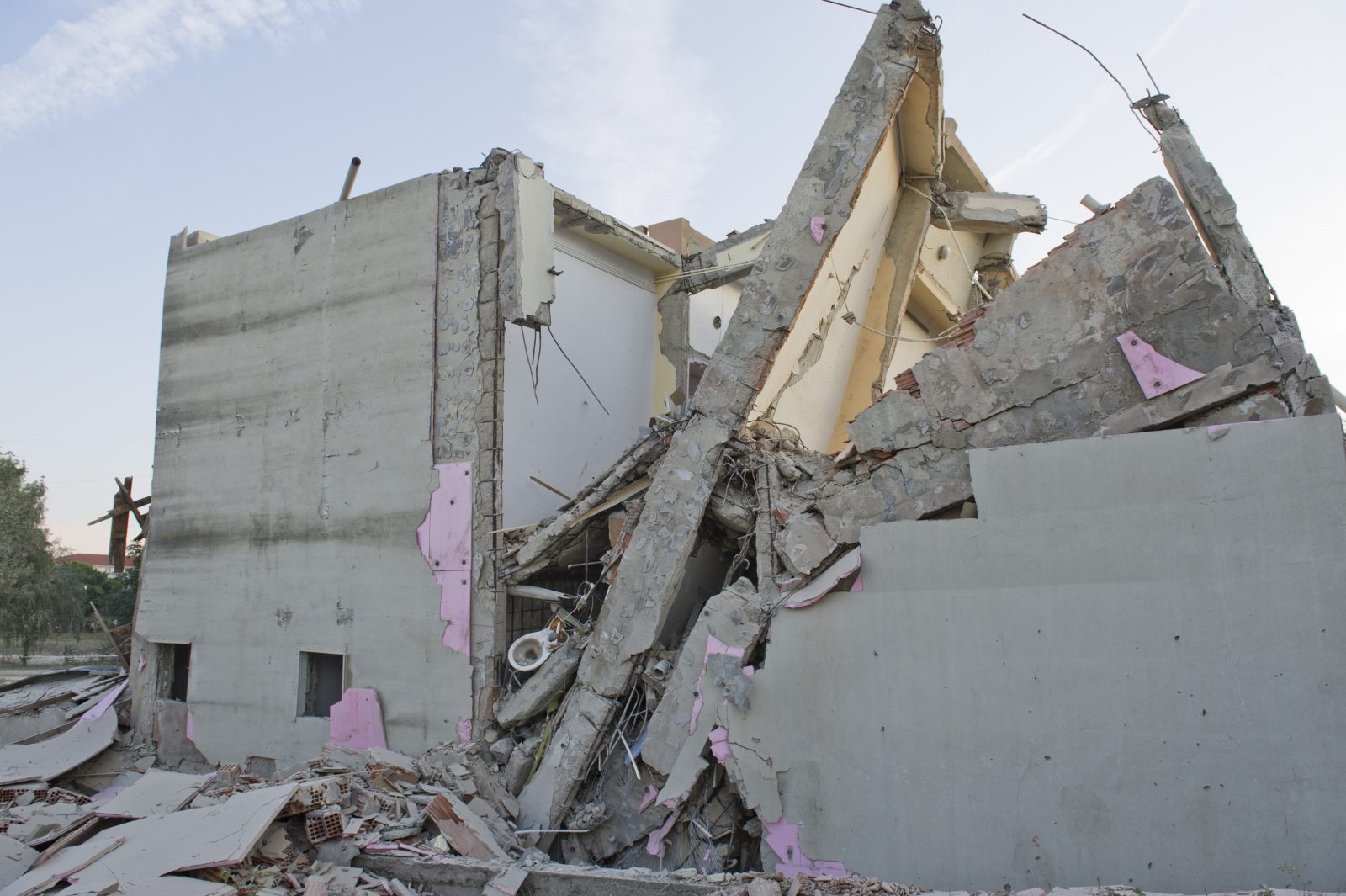
Reports and imagery from affected areas showed typical earthquake-related reinforced-concrete failures, including:
- Complete collapse of older concrete apartment buildings.
- Pancake-type floor failures and progressive collapses in multi-story structures.
- Severe cracking and damage to concrete walls, columns, and unreinforced masonry infill systems.
By early July, authorities reported roughly 800 building collapses, including nearly 200 structures destroyed. Satellite-based assessments suggested tens of thousands of buildings may have sustained at least some damage.
Strong motion sensors are in the area, but their recordings are not yet publicly available. Shaking intensities reached approximately Modified Mercalli Intensity (MMI) IX (“Violent”) levels in the most severely affected areas. MMI is a more qualitative measure of ground motion than peak ground acceleration (PGA). Still, empirical correlations suggest that PGA could be 0.5g or higher, where g is the acceleration due to gravity. This PGA is comparable to the expected highest severe ground shaking in California.

Caracas, Venezuela.
The 2026 Venezuela earthquake sequence occurred along the boundary between the Caribbean and South American Plates. The rupture was associated with right-lateral strike-slip motion (as on the San Andreas Fault) along the San Sebastián Fault System, one of the principal faults that accommodates east-west motion between the two plates. The magnitude 7.5 event was very shallow, resulting in strong surface ground motion. Additionally, the rupture is reported to have focused energy eastward toward Caracas, and the long-period motions of a more distant earthquake would excite taller buildings, which may have been amplified in the Caracas basin, a phenomenon observed in past earthquakes, including in Mexico City in 1985 and Caracas in 1967.
Caracas sits in a valley basin with varying soil conditions and a history of seismic amplification concerns. The 1967 Caracas earthquake prompted extensive studies of local site effects, which influenced later Venezuelan seismic provisions. The current seismic code in Venezuela (COVENIN 1756-1:2019) includes modern hazard and site-class considerations developed in part based on the 1967 earthquake.
The back-to-back 2026 events likely increased cumulative demand on the structures. Further, it is likely that some of the badly damaged buildings were weakened by the 1967 Caracas earthquake and were already in a weakened condition.
Why Did So Many Concrete Buildings Collapse?
The strong ground motion discussed above was a primary contributor to the extensive damage observed. Preliminary engineering observations suggest that the worst-performing buildings were generally older reinforced-concrete structures constructed before building codes established modern seismic detailing requirements. Reported collapse mechanisms included floor-by-floor (“pancake”) collapse, severe column damage, and loss of lateral-load resistance. Engineers have identified non-ductile concrete (NDC) detailing, inadequate confinement reinforcement, soft-story conditions, aging building stock, and possible soil amplification as contributing factors. The density of the older concrete buildings in the epicentral area exceeds that in most of California.

Los Corales, La Guaira, Venezuela.
Venezuela does not have a single comprehensive building code equivalent to the International Building Code (IBC). Instead, design is governed by a series of COVENIN standards (Normas Venezolanas), with separate standards for seismic design, concrete, steel, loads, and other materials. The table below shows the evolution of Venezuela’s seismic building code.
| Year | Standard |
| 1939 | MOP-1939 |
| 1967 | MOP-1967 |
| 1982 | COVENIN 1756-1982 |
| 1998 (rev. 2001) | COVENIN 1756:1998 / Rev. 2001 |
| 2019 | COVENIN 1756-1:2019 (current) |
Many of the apartment towers damaged in Caracas and La Guaira were likely designed under 1982 or earlier standards.
Why Is This Relevant to California?
Many of the vulnerable Venezuelan buildings share characteristics with a class of buildings that also exists in California: older NDC buildings constructed before building codes adopted modern seismic detailing requirements.
Common vulnerabilities include:
- Widely spaced column ties.
- Poor beam-column joint detailing.
- Limited confinement reinforcement.
- Soft-story configurations.
These are the same issues that have led many California jurisdictions, including San Francisco and Los Angeles, to study, inventory, and, in some cases, require evaluation or retrofitting of non-ductile concrete buildings.
What Is the Most Important Lesson?
The Venezuela earthquake reinforces a lesson learned repeatedly in earthquakes worldwide—buildings do not typically fail because earthquakes exceed modern code expectations; they fail because they were designed to codes that did not include modern seismic design knowledge, and this can be exacerbated by damage in previous earthquakes, building modifications, or poor maintenance (e.g., corroded rebar).
What Should Owners of Older California Concrete Buildings Consider?
If your building was constructed before approximately 1980, particularly if it is a reinforced-concrete frame structure (as opposed to one with many concrete walls), it is worth asking:
- Has the building ever undergone a seismic evaluation?
- Is it classified as an NDC building?
- Are there known soft-story or torsional irregularities that increase the likelihood of substantial damage in a major earthquake?
- Is the performance goal to protect life only (typical of residential or commercial buildings), or remain operational after a major earthquake?
Even if retrofit is not currently mandated, owners should understand their building’s expected performance during a major California earthquake so they can make informed decisions.
Bottom Line
The 2026 Venezuela earthquake was likely caused by a combination of a very strong and shallow earthquake sequence, probable local amplification effects, and a large inventory of older reinforced-concrete buildings lacking modern ductile seismic detailing.
This disaster serves as a powerful reminder that the greatest seismic risk often lies in older concrete buildings constructed before the design code required modern ductile detailing requirements. Many of the vulnerabilities identified in the collapsed Venezuelan buildings also exist in older concrete buildings throughout California. While modern concrete design philosophy is similar in both countries, the performance gap between older and newer buildings can be dramatic. For owners of older concrete buildings (pre-1980) in California, a seismic evaluation may be one of the most cost-effective ways to assess risk and make informed retrofit decisions before the next major earthquake.
—
NOTE: A magnitude 7.4 earthquake struck Colombia on 10 August 2026, causing extensive damage. We will provide a summary of that earthquake once sufficient information is available.